
Research on the sensitivity of parameters and calibrates DNDC model for calculating emissions from paddy rice cultivation activities
Keywords:
CH4, DNDC, greenhouse gases, model calibration, N20, sensitivity of modelAbstract
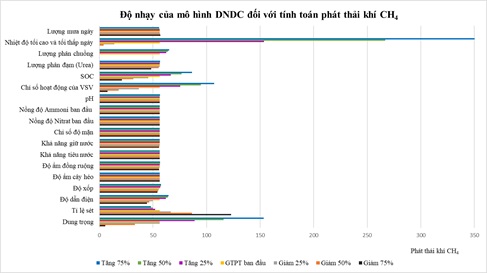
This study estimates the sensitivity of parameters to serve the adjustment and construction of standard parameters in the Decomposition - Denitrification (DNDC) model when calculating greenhouse gas emissions from rice cultivation on alluvial, alkali, acid-sulfate, and bleached soils of Red river delta, Vietnam. The research results show that the following parameters: bulk density, clay fraction, microbial activity index, soil organic carbon (SOC), temperature, conductivity, fertilization of urea, and porosity have a high sensitivity for the calculation of CH4 emissions; the following parameters: pH, drainage efficiency, depth of water retention layer, field capacity, initial nitrate and ammonium concentrations at surface soil, and rainfall have a low sensitivity and less influence for the calculation of CH4 emissions; the wilt moisture and salinity index have no effect on CH4 emissions. In case of N2O emissions, the following parameters: amount of manure, clay fraction, microbial activity index, pH, initial nitrate concentration at surface soil, bulk density, SOC, field capacity, porosity and depth of water retention layer have a high sensitivity and more influence to N2O emissions; the following parameters: drainage efficiency, conductivity, initial ammonium concentration at surface soil, temperature, fertilization of urea and rainfall have a low sensitivity and less influence to N2O emissions; the wilting point and soil salinity index have no effect on N2O emissions. The results of model calibration show a good correlation between observed and simulated values in both spring and summer crops in 2018. The R2 of the spring and summer crops reach 0.86 and 0.79, the Nash-Sutclitffe efficiency index reach 0.82 and 0.77 for CH4 emission; meanwhile for N2O emission, these values are 0.62, 0.69 and 0.76, respectively. The study also found a model calibration parameter used to calculate greenhouse gas emissions from rice cultivation on alluvial, alkali, acid-sulfate, and bleached soils.
DOI:
https://doi.org/10.31276/VJST.63(6).11-17Classification number
1.5
Downloads
Published
Received 25 December 2020; accepted 12 March 2021



