
The impact of climate change to the vulnerability of people’s livelihood in Ho Chi Minh City
Keywords:
Capital, climate change, livelihood vulnerabilityAbstract
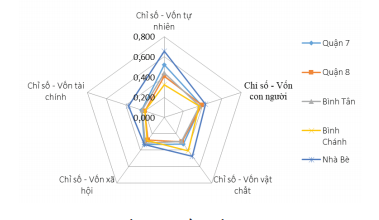
The southern area of Ho Chi Minh City consists of District 7, District 8, Binh Tan, Binh Chanh and Nha Be districts. Since it is naturally characterized as a low land area (more than 80% of the area has an altitude of 2.0 m below sea level), it is strongly influenced by climate change, especially sea level rise, which has a lot of effects on the people’s livelihood. With the goal of assessing the level of livelihood vulnerability due to climate change, the research has applied the method of calculating livelihood vulnerability index recommended by Hahn and his coworkers based on the criteria of DFID for the assessment. The calculation shows that the livelihood vulnerability index for the whole area is low (LVI = 0.354), but medium for Nha Be district (LVI = 0.452). The other districts have low livelihood vulnerability index (LVI is from 0.314 to 0.360). This shows that the impacts of climate change on the livelihood of people living inner Ho Chi Minh City are not many, but that of people the suburbs (Nha Be district) is significant.
Classification number
5.4
Downloads
Published
Received: 11 January 2018; accepted: 20 March 2018



