
Causes and characteristics of amblyopia in children seen at the national institute of ophthalmology
Keywords:
tật khúc xạ, refractive errorAbstract
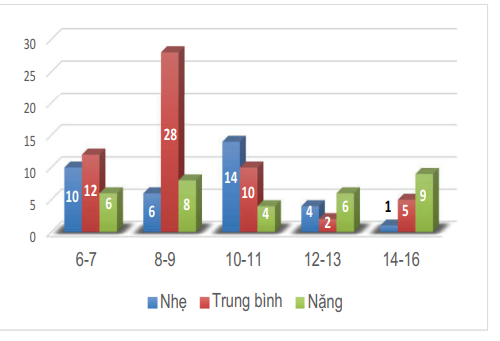
Objective: The study aimed to determine causes and characteristics of amblyopia in children seen at the National institute of ophthalmology. Subjects and methods: Assessment of visual acuity (VA) and refraction with and without cycloplegia. Criteria of amblyopia: best corrected VA < 20/30 or difference of VA between eyes ≥ 2 lines. Amblyopia was classified as anisometropia if there was more than 1.0D between eyes, as strabismus if there was manifest strabismus, and as high refractive error if the refractive error was more than 5.0D. Results: 125 patients, aged from 6 to 16 (average 9.74±2.76), males accounted for 58.4%, and females made up 41.6%. Monocular amblyopia was 59.2%, and binocular amblyopia was 40.8%. Hypermetropic eyes accounted for 47.2%, and myopic eyes 23.2%. The majority of moderate and mild amblyopia was in the age group from 6 to 11. The majority of severe amblyopia was in the age group from 12 to 16. 44.8% of eyes had VA < 20/40. The most common cause was anisometropia (54.4%), followed by strabismus (32%). Conclusions: Prevalence of amblyopia was 4.94%. The rate of VA < 20/40 was nearly 50%. The causes of amblyopia were anisometropia, strabismus, and high refractive errors. The mild and moderate amblyopia was more common in anisometropic patients, while the severe amblyopia was more common in strabismic patients.
Classification number
3.2
Downloads
Published
Received: 16 February 2017; accepted: 7 April 2017



