
Improvement for rice genotypes with phosphorous deficiency tolerance using conventional and markerassisted selective breedings
Keywords:
Marker-assisted selection, P-deficiency tolerance, PSTol gene, Pup-1 gene, QTL, relative tillering abilityAbstract
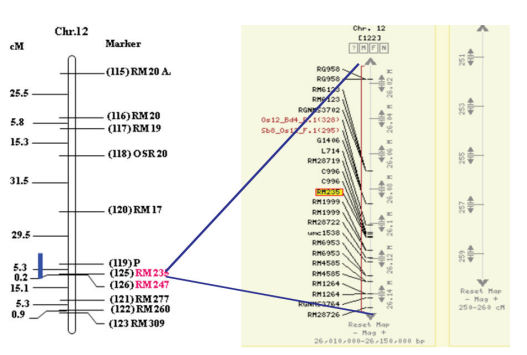
High-yielding rice genotypes with phosphorous (P) deficiency tolerance have been a key demand in the rice production on acid sulfate soils. A derivative line namely AS996 from Oryza rufipogon is the donor of P-deficiency tolerance in the study. Populations of F2 and RIL7 from the crosses viz. OM2395/AS996 and OM2717/AS996 were tested to analyse QTLs through 126 polymorphic SSRs. Agronomical traits related to P-deficiency tolerance could be concluded as relative tillering ability (RTA), relative shoot dry weight (RSDW), relative root dry weight (RRDW), relative shoot length (RSL), and relative root length (RRL). The putative QTLs were identified on the chromosomes 1, 2, 5, 9, and 12. Among them, the chromosome 12 was considered the most important one because of the presence by Pup-1 or/and PSTol loci.
Classification number
4.6
Downloads
Published
Received: 6 March 2017; accepted: 31 March 2017



