
Current status of Stump-tailed macaque (Macaca arctoides), Rhesus macaque (Macaca mulatta) and Assamese macaque (Macaca asamensis) in Xuan Lien Nature Reserve, Thanh Hoa province
Keywords:
Arctoides, Assamensis, Macaca, macaque, Mullata, primates, Xuan Lien Nature ReserveAbstract
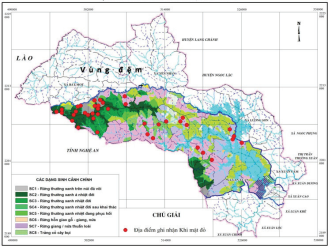
This study was conducted in Xuan Lien Nature Reserve (NR), Thanh Hoa Province during 2015-2016. The study results confirmed the appearances of Stump-tailed macaque, Rhesus macaque and Assamese macaque in Xuan Lien NR. Stump-tailed macaque has a large distribution range, covering 13 of total 30 forest sub-areas and 7 of total 8 forest habitats in Xuan Lien NR. The identified habitats of Stump-tailed macaques are Limestone evergreen forest (SC1), Subtropical evergreen forest (SC2), Tropical evergreen forest (SC3), Tropical evergreen forest affected by selective timber logging in the past (SC4), Regenerated evergreen forest (SC5), Mixed wood-bamboo forest (SC6), and Bamboo forest (SC7). Rhesus macaque also has a large distribution range, covering 11 forest sub-areas and 6 forest habitats (SC1-SC6). In contrast, Assamese macaque has a very small distribution range, covering only 8 forest sub-areas and 3 forest habitats (SC1-SC3). Forest quality and intensity of human impact on the forest habitats have a great influence on the occupancy area of the macaque species. The encounter rate of macaque troops in the forest is 0.0833 group/km for Stump-tailed macaque, 0.0625 group/km for Rhesus macaque, and 0.03125 group/km for Assamese macaque. These low encounter rates indicate low and very low abundances of the macaque species in Xuan Lien NR. The study also shows that the 3 most important forest habitats for macaque conservation in Xuan Lien NR are Limestone evergreen forest (SC1), Subtropical evergreen forest (SC2), and Tropical evergreen forest (SC3). Consequently, the most important areas for macaque species conservation in Xuan Lien NR are forest compartments as follows: 484, 485, 489, 495, 497, 499, 500, 512, and 516, which support the above 3 most important habitats.
Classification number
1.6
Downloads
Published
Received: 1 February 2018; accepted: 29 March 2018



