
Association of carbapenem resistance levels with the presence of carbapenemase coding genes among Acinetobacter baumannii strains isolated from some hospitals
Keywords:
A. baumannii, MIC carbapenem, MIC colistinAbstract
In addition to virulence factors, antibiotic resistance
has helped strains of Acinetobacter baumannii become
one of the most common agents of hospital-acquired
infections. In A. baumannii, carbapenem resistance is
mainly mediated by carbapenemase. In this study, 144
strains of A. baumannii isolated from 9 hospitals in
representing 3 regions of Vietnam were studied to detect
the minimum inhibitory concentration (MIC) and find
an association between carbapenem resistance levels and
the appearance of some carbapenemase coding genes.
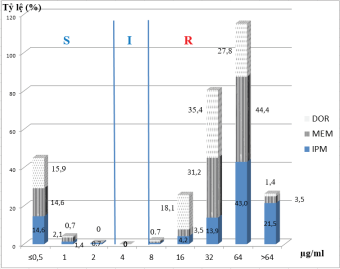
Results: more than 70.8% of the isolated were resistant
to 7/9 antibiotics tested; 83.3% strains were resistant to
3 carbapenem antibiotics with MIC50, and MIC90 values
were 32-64 µg/ml and ≥64 µg/ml, respectively; 100%
strains were susceptible to colistin (MIC50=0.25 µg/ml
and MIC
90=0.5 µg/ml). Strains with only blaOXA-51 showed
much lower rates of antibiotic resistance and MIC than
those with ≥2 carbapenemase genes (p<0.01). 100%
strains carrying blaOXA-23 and blaNDM-1 were resistant to
carbapenem with very high MIC values. Conclusion:
there is an association between carbapenem resistance
and the appearance of gene blaOXA-23 and blaNDM-1. Colistin
is the last resort for the treatment of multidrug-resistant
A. baumannii.
Classification number
3.5
Downloads
Published
Received 2 April 2020; accepted 7 May 2020



