A theoretical study on reaction mechanism of thermal decomposition of furyl radicals
Keywords:
lignocellulose, biofuel,, furyl radical, thermal decompositionAbstract
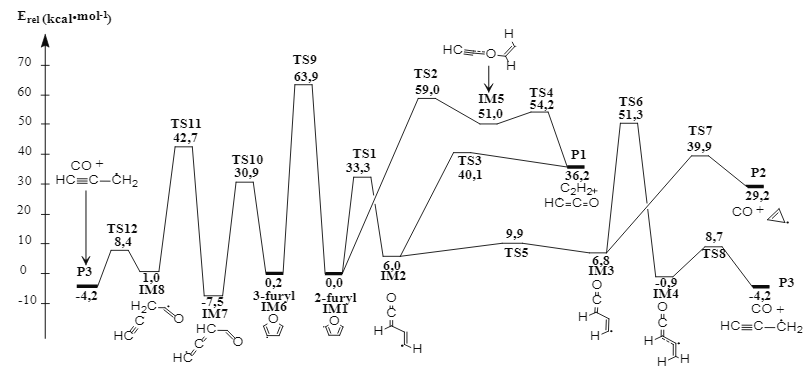
This study presents the reaction mechanism of furyl decomposition, which plays an important role in the production of the second-generation biofuels from lignocellulosic feedstock. The reaction mechanism was explored using the highly accurate ab initio composite method CBS-QB3. It was found that (i) the conversion of 2-furyl 3-furyl was unfavorable due to its high energy barrier (63.9 kcal∙mol-1 at 0 K); (ii) 2-furyl could be decomposed in to three product channels in the increasing thermodynamically favorable order as C2 H2 & •HC=C=O (P1) > CO & c-C3 H3 • (P2) > CO & HC≡C‒CH2 • (P3); and (iii) 3-furyl only decomposed to P3 products. The calculated thermodynamic properties (such as heat of formation, entropy, heat capacity) for the temperature range of 298-2,000 K were in good agreement with the limited and scattered literature data; therefore, the calculated data could be used for further study in modelling and simulation of furyl-related system as well as the lignocellulosic bioconversion technology
Classification number